Home > Nickel Alloy > Nickel Alloy 200 Flanges
Nickel Alloy 200 Flanges are essential components in piping networks, valued for their outstanding resistance to corrosion, strength at high temperatures, and remarkable mechanical characteristics. Extensively used across a range of industries such as chemical processing, petrochemical, oil and gas, power generation, aerospace, and marine sectors, these flanges deliver dependable performance in corrosive settings and under high temperatures. Whether confronting harsh chemicals or severe conditions, Nickel Alloy 200 Flanges serve as trustworthy components, bringing durability and effectiveness to vital applications.
| Dimensions | ASTM B564 / B182 |
| Grades | 200 (N02200), 201 (N02201), Alloy 20 (N08020). |
| Size | 1/8″ NB TO 48″ NB. |
| Class | 150#, 300#, 400#, 600#, 900#, 1500#, 2500#, 3000#. Also as per the National & International Standard. |
| Standard | SORF, SOFF, SOLJ, SWFF, WNRF, WNFF, WNRTJ, LWNRF, BLRF, BLFF, BLRTJ, SWRF, LAP Joint, Threaded, Reducing, Spectacle, Orifice & Studding Outlet are manufactured according to ANSI B 16.5, B 16.47 Series A (MSS SP-44), B 16.47 Series B (API 605), MSS SP-43, DIN 2527, DIN 2566, DIN 2576, DIN 2632, DIN 2633, DIN 2634, DIN 2635, DIN 2642, BS 10, IS 1538 & IS 6392, etc |
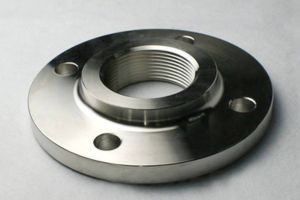
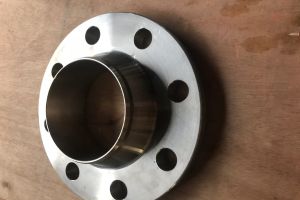
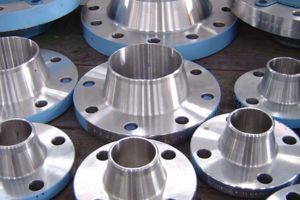
| Types of Flanges | Weld neck Flanges (WNRF), Slip-on Flanges (SORF), Blind Flanges (BLRF), Lap Joint Flanges, (SOLJ), Socket-weld Flanges (SWRF), Screwed (Threaded) Flanges, Long weld neck Flanges (LWNRF), Spectacle Blind Flanges, Spacer & Blind Flanges, Ring Type Joint Flanges (RTJ), Reducing Flanges, Raised Face (RF) Flanges, Orifice Flanges, Deck Flange, Large Diameter Flanges, Custom Flanges, Drawing Flanges, Forged Flanges, Plate Flanges, Flat Face Flanges, etc. |
| Form | Slip-On Flange (SO), Blind Flange (BL), Lap Joint Flange (LF), Socketweld Flange (SW), Weld Neck Flange (WN), Long Weld Neck Flange (LWN), Ring Type Joint (RTJ), Threaded Flange, Customized Flange with Raised Face (RF), Flat Face (FF). |
| Grade | Ni | Fe | C | Mn | Si | Cu | Ti | S |
| Nickel 200 | 99.0 min | 0.4 max | 0.15 max | 0.35 max | 0.1 max | 0.25 max | – | 0.01 max |
| Element | Density | Melting Point | Tensile Strength | Yield Strength (0.2%Offset) | Elongation |
|---|---|---|---|---|---|
| Nickel 200 | 8.9 g/cm3 | 1446 °C (2635 °F) | Psi – 67000 , MPa – 462 | Psi – 21500 , MPa – 148 | 45 % | /tr>
At Sumakhsteel, we take pride in being the largest supplier and manufacturer in the USA, delivering advanced solutions for every one of your piping requirements. With cutting-edge manufacturing facilities strategically positioned across the USA, we maintain an extensive stock of more than 25,000 tons of top-grade materials kept ready and available in inventory.
Get in touch with us for a fast quote tailored to your requirement.
Nos flanges en alliage de nickel 200 sont proposées conformément aux normes DIN, ISO, JIS ou ANSI.
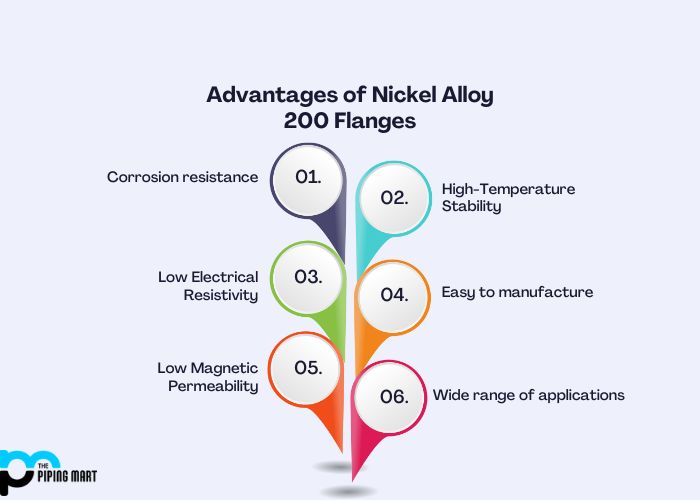
Corrosion Resistance: Nickel alloy 200 offers outstanding resistance to corrosion, particularly in alkaline settings like those encountered in chemical processing, food processing, and marine applications, which makes this corrosion well suited for use in corrosion and chemical environments.
High thermal stability: Nickel alloys keep their mechanical properties even when temperatures exceed 200, which makes them appropriate for high-temperature uses where they operate at high temperatures, such as the petrochemical and electrical industries; this characteristic matters for flanges used in those applications.
Low electrical resistivity: Nickel alloy has a low electrical resistance of 200, which makes it valuable wherever electrical conductivity is essential, such as in electrical engineering and electronics
Easy to manufacture: Thanks to its excellent flexibility and elasticity, nickel alloy 200 is readily shaped into a range of forms, including flanges. This characteristic streamlines the fabrication process and allows complex shapes to be produced with relative ease.
Low Magnetic Permeability: The nickel alloy has a low magnetic permeability of 200, which makes it appropriate for uses where magnetic interference needs to be minimal, such as electronics and certain medical devices
Wide range of applications: Owing to its outstanding blend of properties, nickel alloy 200 flanges are used across a variety of industries, including pharmaceutical, petrochemical, food processing, marine, aerospace and electronics
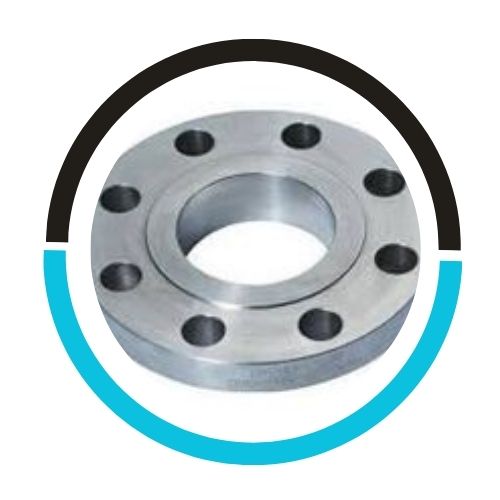

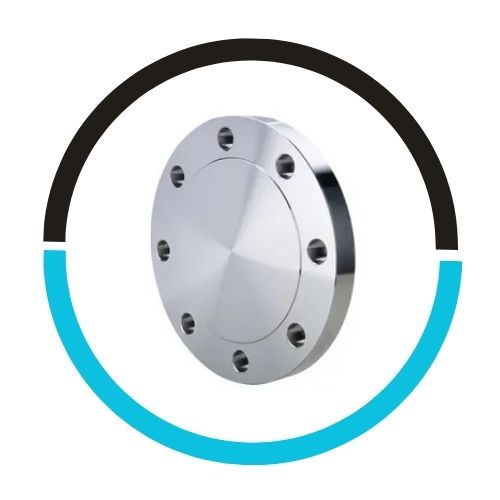



Nickel alloy 200 flanges are extensively used across a range of industries thanks to their outstanding corrosion resistance, strength at high temperatures, and excellent mechanical properties. Frequently seen in chemical processing plants, petrochemical refineries, oil and gas exploration facilities, power generation plants, aerospace applications, and marine environments, these flanges join pipes, valves, and equipment under challenging operating conditions.
Chemical applications: Nickel alloy 200 flanges are frequently employed in chemical settings that involve corrosive chemicals. They deliver outstanding resistance to acids, alkalis and other corrosive substances.
Power performance: Within electrical equipment, nickel alloy 200 flanges are put to use in applications like valves, piping systems, and heat exchangers, where they can endure high temperatures and pressures without deteriorating.
Oil and Gas Industry: Flanges constructed from nickel alloy 200 serve the offshore and onshore oil and gas industry thanks to their resistance to seawater corrosion and the environmental hazards found in oil and due to gas production
Aerospace: Nickel alloy 200 flanges are applied in aircraft and aerospace uses that call for lightweight materials offering high strength and extreme heat resistance.
Marine Applications: Owing to the corrosion resistance of nickel alloy 200 flanges, seawater is typically set aside for use in fixtures, pipelines, and other marine applications in the environment
Food Processing: In the food and beverage sector, where corrosion resistance is needed to uphold hygiene and safety standards, nickel alloy 200 flanges are utilized in equipment such as tanks, piping, and machines a in the manufacturing process
Application Requirements: Identify the particular use case for which the flange is required. Nickel alloys have a reputation for outstanding corrosion resistance across 200 different areas, so if resisting corrosion is a critical need, this alloy could be a good fit.
Conditions of Use: Take into account the temperature, pressure, and other surrounding conditions that will affect the flanges. Nickel alloy 200 offers excellent mechanical characteristics and can endure high temperatures, which makes it well suited for high-temperature uses.
Compatibility: Make sure that Nickel Alloy 200 flanges work well with the other parts of your system, such as piping, valves and fittings. Misalignment can lead to corrosion and additional problems as time goes on.
Size and Dimensions: Work out the correct size and dimensions for the flange. Flanges are available in numerous sizes and pressure ratings based on the piping system in which they will be installed, so pick the one that best matches your requirements
Standards and Specifications: Verify any particular industry standards or specifications that the flange has to comply with. This guarantees that the quality and performance benchmarks of your application are satisfied.
Supplier Reputation: Select a trustworthy supplier or manufacturer with a proven history of supplying high-quality Nickel Alloy 200 flanges. Examine certifications and quality control processes to confirm product quality.
Cost Considerations: Although quality may be the top priority, take into account the cost effects of the different options. Compare pricing from various suppliers and balance factors like quality, reliability and service support.
Nickel Alloy 200 flanges show outstanding resistance to galvanic corrosion thanks to their high nickel content, which creates a protective oxide layer. When combined with compatible materials, like stainless steel or nickel alloys, the risk of galvanic corrosion is reduced, making them appropriate for a wide range of environments.
| Flange Weights by Pressure Class and Size | ||||||||||||||||||
| Pipe Size | 150 # | 300 # | 600 # | 900 # | 1500 # | 2500 # | ||||||||||||
| WN | SO | BLD | WN | SO | BLD | WN | SO | BLD | WN | SO | BLD | WN | SO | BLD | WN | SO | BLD | |
| 1/2″ | 2 | 1 | 1 | 2 | 1 | 1 | 2 | 2 | 2 | SEE 1500 # WEIGHTS | 5 | 4 | 4 | 7 | 7 | 7 | ||
| 3/4″ | 2 | 2 | 2 | 3 | 3 | 3 | 4 | 3 | 3 | SEE 1500 # WEIGHTS | 6 | 5 | 6 | 8 | 8 | 8 | ||
| 1″ | 3 | 2 | 2 | 4 | 3 | 3 | 4 | 4 | 4 | SEE 1500 # WEIGHTS | 9 | 8 | 8 | 12 | 11 | 11 | ||
| 1 1/2″ | 4 | 3 | 3 | 7 | 6 | 6 | 8 | 7 | 8 | SEE 1500 # WEIGHTS | 13 | 12 | 13 | 25 | 22 | 23 | ||
| 2″ | 6 | 5 | 5 | 9 | 7 | 8 | 12 | 9 | 10 | SEE 1500 # WEIGHTS | 25 | 25 | 25 | 42 | 37 | 39 | ||
| 2 1/2″ | 8 | 7 | 7 | 12 | 10 | 12 | 18 | 13 | 15 | SEE 1500 # WEIGHTS | 36 | 36 | 35 | 52 | 55 | 56 | ||
| 3″ | 10 | 8 | 9 | 15 | 13 | 16 | 23 | 16 | 20 | 31 | 26 | 29 | 48 | 48 | 48 | 94 | 83 | 86 |
| 4″ | 15 | 13 | 17 | 25 | 22 | 27 | 42 | 37 | 41 | 53 | 53 | 54 | 73 | 73 | 73 | 145 | 125 | 130 |
| 5″ | 19 | 15 | 20 | 32 | 28 | 35 | 68 | 63 | 68 | 86 | 83 | 87 | 130 | 130 | 140 | 245 | 210 | 225 |
| 6″ | 24 | 19 | 26 | 42 | 39 | 50 | 81 | 80 | 86 | 110 | 110 | 115 | 165 | 165 | 160 | 380 | 325 | 345 |
| 8″ | 39 | 30 | 45 | 67 | 58 | 81 | 120 | 115 | 140 | 175 | 170 | 200 | 275 | 260 | 300 | 580 | 485 | 530 |
| 10″ | 52 | 43 | 70 | 91 | 81 | 124 | 190 | 170 | 230 | 260 | 245 | 290 | 455 | 435 | 510 | 1075 | 930 | 1025 |
| 12″ | 80 | 64 | 110 | 140 | 115 | 185 | 225 | 200 | 295 | 325 | 325 | 415 | 690 | 580 | 690 | 1525 | 1100 | 1300 |
| 14″ | 110 | 90 | 140 | 180 | 165 | 250 | 280 | 230 | 355 | 400 | 400 | 520 | 940 | NA | 975 | NA | NA | NA |
| 16″ | 140 | 98 | 180 | 250 | 190 | 295 | 390 | 330 | 495 | 495 | 425 | 600 | 1250 | NA | 1300 | NA | NA | NA |
| 18″ | 150 | 130 | 220 | 320 | 250 | 395 | 475 | 400 | 630 | 680 | 600 | 850 | 1625 | NA | 1750 | NA | NA | NA |
| 20″ | 180 | 165 | 285 | 400 | 315 | 505 | 590 | 510 | 810 | 830 | 730 | 1075 | 2050 | NA | 2225 | NA | NA | NA |
| 22″ | 225 | 185 | 355 | 465 | 370 | 640 | 720 | 590 | 1000 | NA | NA | NA | NA | NA | NA | NA | NA | NA |
| 24″ | 260 | 220 | 430 | 580 | 475 | 790 | 830 | 730 | 1250 | 1500 | 1400 | 2025 | 3325 | NA | 3625 | NA | NA | NA |
Nickel Alloy 200 flanges are suitable for underground applications where resistance to corrosion is essential. Their outstanding ability to withstand corrosion across a range of environments, including underground settings, makes them ideal for pipelines, chemical processing plants, and other underground infrastructure projects, delivering lasting reliability and performance.
Yes, Nickel 200 Alloy flanges can be welded using a range of welding methods, including gas tungsten arc welding (GTAW), gas metal arc welding (GMAW), and shielded metal arc welding.
When choosing Nickel Alloy 200 flanges, take into account aspects like resistance to corrosion, suitability for operating conditions, size and dimensions, conformity to standards, the supplier’s reputation, value for money, options for customization, testing and inspection, and ongoing support to guarantee the right fit and performance for your particular application requirements.
Call Us: +91 7208967217
Email: sales@sumakhsteel.com