Home > Nickel Alloy > Nickel Alloy Bolts
Set out on a path toward outstanding performance with our Nickel Alloy Bolts, prominently featured on our product pages. We offer a wide selection of top-tier solutions carefully designed to meet a range of industrial needs. Enter a world of flexibility and reliability with our thoughtfully engineered products built for a broad range of industrial uses. Our products feature precisely crafted designs that comply with rigorous industry standards, highlighting durability and corrosion resistance. As a reliable supplier, customer satisfaction remains our top priority, shown through our adaptable options, competitive pricing, and fast delivery services. Whether for construction, manufacturing, or engineering projects, our duplex steel bolts represent excellence and innovation, providing unmatched performance. Our steadfast dedication to perfection strengthens your business with dependable solutions, ensuring success and confidence in every transaction.
| Specifications | ASTM B 160 ASME SB 160 |
| Standard | DIN, ASTM, BS and all International Standards |
| Length | 3 mm to 200 mm |
| Size | M3 – M56 | 3/6″ to 2″ | Custom Sizes |
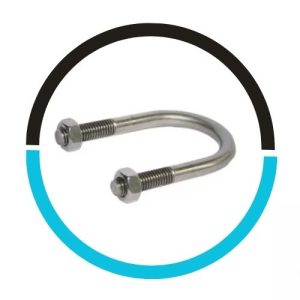
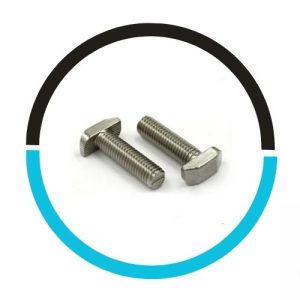
| Type | Hex Head Bolts, Square Bolts, U bolts, Eye bolts, T bolt, Hex Bolt, Lag Bolts, Counter sunk Bolts, Hex Head nuts, Square nuts, Lock nuts, Eye nuts, wing nuts, T nuts, Panel Nuts, Coupling Nuts, Dome nuts, Acorn Nuts. |
| Density | Melting Point | Yield Strength (0.2%Offset) | Tensile Strength | Elongation |
| 8.9 g/cm3 | 1446 °C (2635 °F) | Psi – 21500 , MPa – 148 | Psi – 67000 , MPa – 462 | 45 % |
| Grade | Ni | C | Mo | Mn | Si | Fe | P | S | Cu | Cr |
| Nickel Alloy | 99.0 min | 0.15 max | – | 0.35 max | 0.1 max | 0.4 max | – | 0.01 max | 0.25 max | – |
| Nickel Alloy | Balance | 0.15 max | – | 0.35 max | 0.35 max | 0.40 max | – | 0.01 max | 0.25 max | – |
At Sumakhsteel, we take great pride in serving as the largest supplier and manufacturer in the USA, delivering advanced solutions for all your piping requirements. With cutting-edge production facilities strategically positioned across the USA, we maintain an extensive stock of more than 25,000 tons of top-quality materials kept readily available in inventory.
Reach out to us to receive a fast quote tailored to your needs.
We supply these Nickel Alloy Bolts in accordance with DIN, ISO, JIS or ANSI Standard.
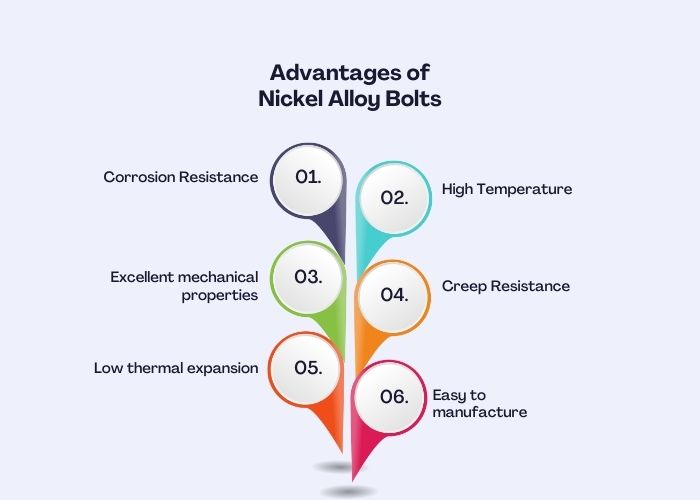
Corrosion Resistance: Nickel alloys offer excellent resistance to corrosion, which makes them well suited for demanding environments like marine, chemical processing, oil and gas, and more. They withstand corrosive attack from both organic and inorganic compounds across acidic and alkaline settings.
High Temperature: Nickel alloys maintain their mechanical characteristics even at elevated temperatures, which makes them perfect for uses where bolts face high heat or thermal cycling. This trait is particularly valuable in aerospace, electricity and the automotive industry.
Excellent mechanical properties: Nickel alloys possess considerable strength, hardness and flexibility, guaranteeing dependable performance across a range of loading conditions. This makes nickel alloy bolts well suited for critical uses where structural integrity is essential
Creep Resistance: Nickel alloys show outstanding resistance to creep, the slow deformation produced by continuous stress at raised temperatures. This characteristic matters for materials subjected to high heat over long durations, such as turbine engines and high-temperature furnaces
Harsh Environmental Compatibility: Nickel alloys keep their properties in extreme situations, such as high pressure, high temperature and environmental corrosion. This capacity to deliver such versatility makes them fitting for a wide range of uses, from deep-sea exploration to air and space propulsion.
Low thermal expansion: Nickel alloys display low thermal expansion, meaning they expand and contract less as temperatures shift. This trait supports the dimensional stability of components under changing temperatures, lowering the chance of bolted joints loosening or failing.
Easy to manufacture: Nickel alloys are readily produced through conventional machining, welding and forging methods. This adaptability lets you tailor bolt systems to satisfy the requirements of particular applications.
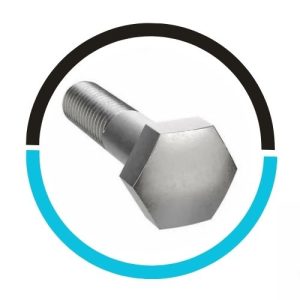
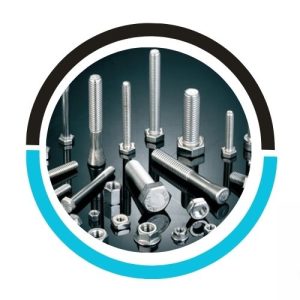
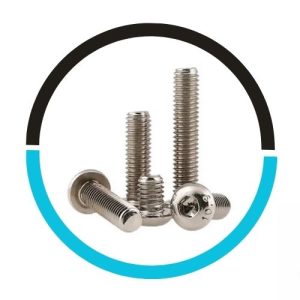
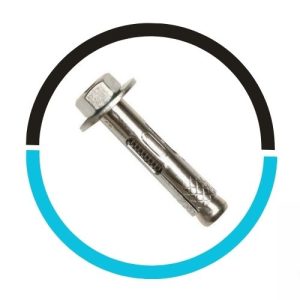
Nickel Alloy Bolts applications are as varied as the industries they cater to, driven chiefly by the aerospace, railway, construction and automotive industries, along with petrochemical, nuclear, medical, Oil & Gas, Chemical, Pharmaceutical, Food & Beverage, Nuclear, Thermal Power plants, Paper and Pulp, marine and mining, etc.
Chemical performance: Bolts crafted from nickel alloy resist corrosion and hold up under high temperatures, which makes them well suited for chemical applications where chemical corrosion and extreme heat frequently occur
Oil & Gas Industry: Nickel alloy bolts are deployed in offshore drilling platforms, refineries and pipelines so they can endure harsh conditions such as salt water, high pressure and temperature
Aerospace: Nickel alloy bolts serve the aerospace industry thanks to their strength-to-weight equivalence, resistance to corrosion and capacity to endure the extreme temperatures met during flight.
Power generation: Nickel alloy bolts appear in turbines, boilers, and other essential components within power plants that need to endure high temperatures and hot weather.
Marine applications: Bolts made from nickel alloy are applied in marine settings where salt water, water and corrosion are contained. They are frequently used in shipbuilding, marine structures and marine equipment.
Medical Devices: Nickel alloy bolts feature in medical devices and equipment because of their biocompatibility, corrosion resistance and strength. They are frequently used in implants and surgical instruments.
Electronics: Nickel bolts are employed in electronics manufacturing owing to their electrical conductivity and corrosion resistance. They are used in communications, circuit boards and electronic enclosures.
Automotive Industry: Nickel alloy bolts are found in the automotive industry, particularly in engine exhaust systems, where they must endure high temperatures and corrosive gases.
Food processing: Nickel alloy bolts are used in food processing equipment where corrosion and high temperatures come into play, guaranteeing adherence to hygiene standards and strong durability in internal environments.
Determine application requirements: Assess the environmental factors, including temperature, pressure, possible damage, and mechanical loads, that the bolts will be subjected to. Nickel comes in numerous alloys. These differ in their resistance to corrosion, elevated temperatures, and other conditions.
Check material specifications: Recognize industry standards or specifications, like those from ASTM (American Society for Testing and Materials) or ASME (American Society of Mechanical Engineers). Such specifications offer direction for choosing suitable materials according to the demands of the application.
Consider corrosion resistance: Nickel alloys are recognized for their outstanding corrosion resistance in severe conditions. Identify the kind of corrosion common in your application (e.g., normal, pitting, crack corrosion) and pick a nickel alloy with suitable resistance.
Check temperature requirements: Nickel alloys perform well under high temperatures. Take into account the temperatures involved in your application and select a nickel alloy capable of enduring those temperatures without sacrificing its mechanical properties.
Check mechanical properties: Based on the application, mechanical properties like tensile strength, yield strength, and flexibility might matter. Verify that the chosen nickel alloy bolts possess the required mechanical properties to endure applied loads and stresses using the mouthpiece.
Compare alloy options: A range of nickel-based alloys exists, each providing distinct properties fit for a specific application. Some widely used nickel bolt types are Inconel, Monel, Hastelloy and Nimonic. Weigh the properties of these blends to identify the one that best matches your requirements.
Consider cost and availability: Evaluate the affordability of the different nickel alloy choices to confirm the chosen products come in the needed shape and size. Keep in mind that certain exotic nickel alloys can be pricier and harder to find than others.
Consult the experts: Should you require clarity on the ideal nickel alloy, seek advice from materials engineers, suppliers, and other metallurgy specialists. They can provide valuable insights and recommendations drawn from their expertise and experience.
Yes, Nickel Alloy Bolts can be recycled. Nickel alloys, including the ones found in bolts, are able to be recycled via several methods like melting and refining to recover the valuable metals for reuse in new products, cutting down the demand for raw materials and environmental impact.
Nickel alloy bolts can display magnetic behavior based on their particular makeup. Nickel on its own is not strongly magnetic, but some nickel alloys, such as Inconel, may include elements like iron that can render them slightly magnetic. That said, the degree of magnetism can differ and may not be substantial.
Nickel alloy bolts may work well for underground uses depending on considerations like corrosion resistance and mechanical characteristics. Certain nickel alloys, such as Monel or Inconel, provide outstanding protection against corrosion caused by moisture and chemicals, which makes them practical options for underground settings where durability and long service life matter greatly.
Nickel alloy bolts are generally not the preferred choice for structural applications because they have lower strength than steel bolts. Although nickel alloys provide outstanding corrosion resistance and stability at high temperatures, they may not possess the mechanical properties needed—such as high tensile strength—for structural use in buildings or bridges.
Phone Us: +91 7208967217
Email: sales@sumakhsteel.com